Beacon - Digital Divination
Design, Development, Divination
I’m fascinated by divination systems and the tools we use to find meaning, whether it be something divine in nature or as mundane as a newspaper. BEACON is a guidance system, a values-based GPS, that helps the user find relationships between landmarks and values, offering them a suggested path and allowing them freedom to follow that path or find their own.
Inspired by tarot, astrology, the I Ching, and countless other systems for understanding, BEACON is a web-based tool for personal reflection. Those references have deep cultural associations, often references to divinity or the act of divination, but they also function as tools outside of the spiritual context. You don’t need to believe in destiny to find value in a tarot reading. The best of these tools redirect questions back to the querent that only they can answer. They function as a mirror.
Creating a map
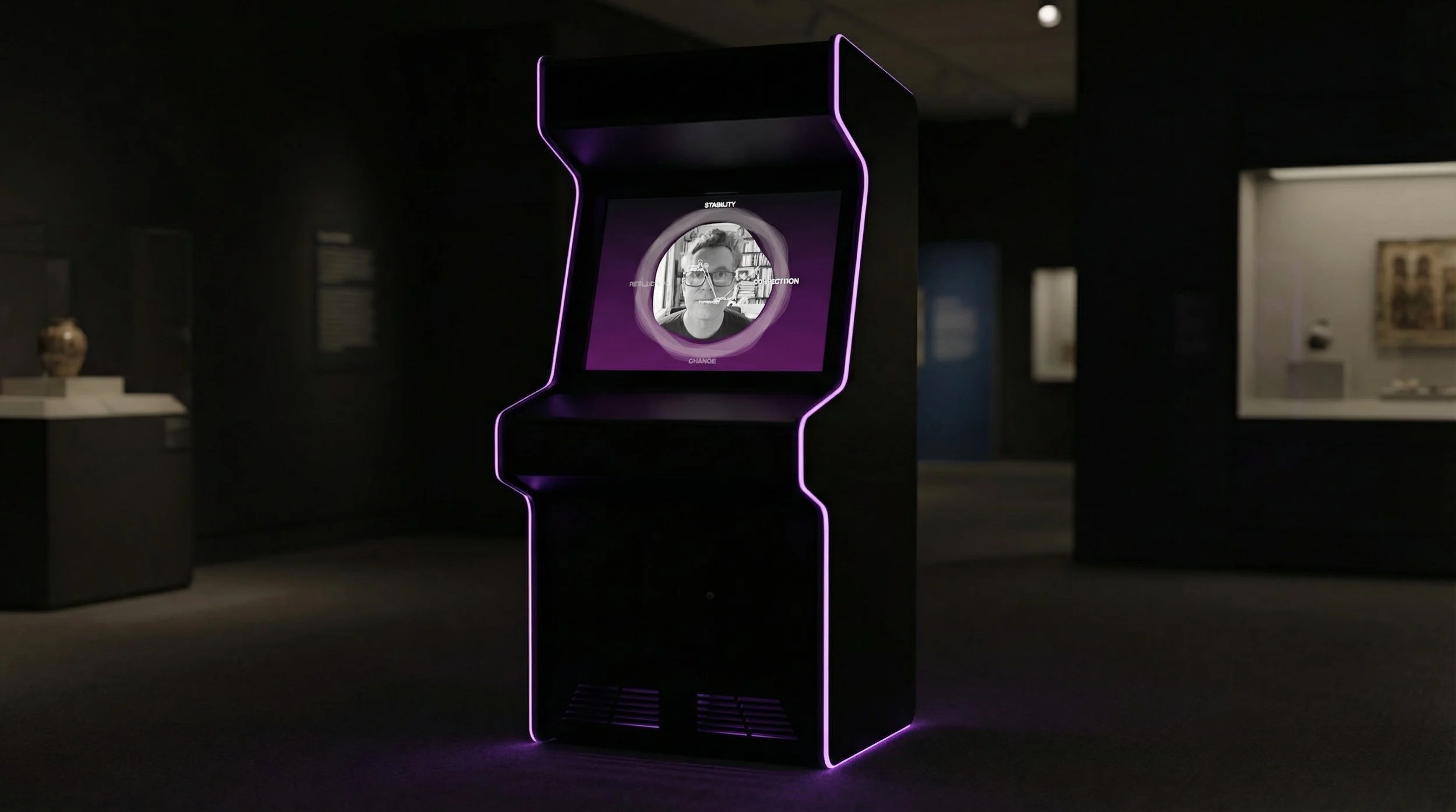
The application uses computer or phone camera to take a picture and draw a constellation map across your portrait. This map represents your journey and the application provides guidance on how to interpret the map. Any decisions you make from using BEACON are your own. It serves to surface your values so you can make better decisions. In that spirit, BEACON is also similar to a mirror, functioning to help you see yourself more clearly.
This project is largely about the personal nature of interpretation, leveraging our tendency to find patterns and meaning in random action or input. It’s up to the viewer to find or dismiss meaning and the system itself doesn’t provide answers, predictions or concrete interpretations. I love the openness of systems that rely on users to express themselves.
finding meaning
Incredibly, nearly every user tester thought the application saw them so clearly that it had to be aware of their social media or that it was built using Artificial Intelligence. But the application doesn’t use AI.
Or rather, it does, but of the Actual Intelligence variety. Meaning, this isn’t Gen AI and doesn’t use an LLM. It hasn’t been trained on any data. The meaning comes from the user. That’s what people do. We find meaning. We connect the dots. We feel seen when something affirms our biases or self concept.
I find that incredible. With the right framing we can learn something about ourselves from nearly anything. Maybe even a simple web-based experiment in divination.
Early experiments
Early sketches were produced using p5.js I made a code-driven face reading/divination program in which I upload a photo then run the program, which draws an expressive, looping, line over the querent’s portrait.


How to use BEACON
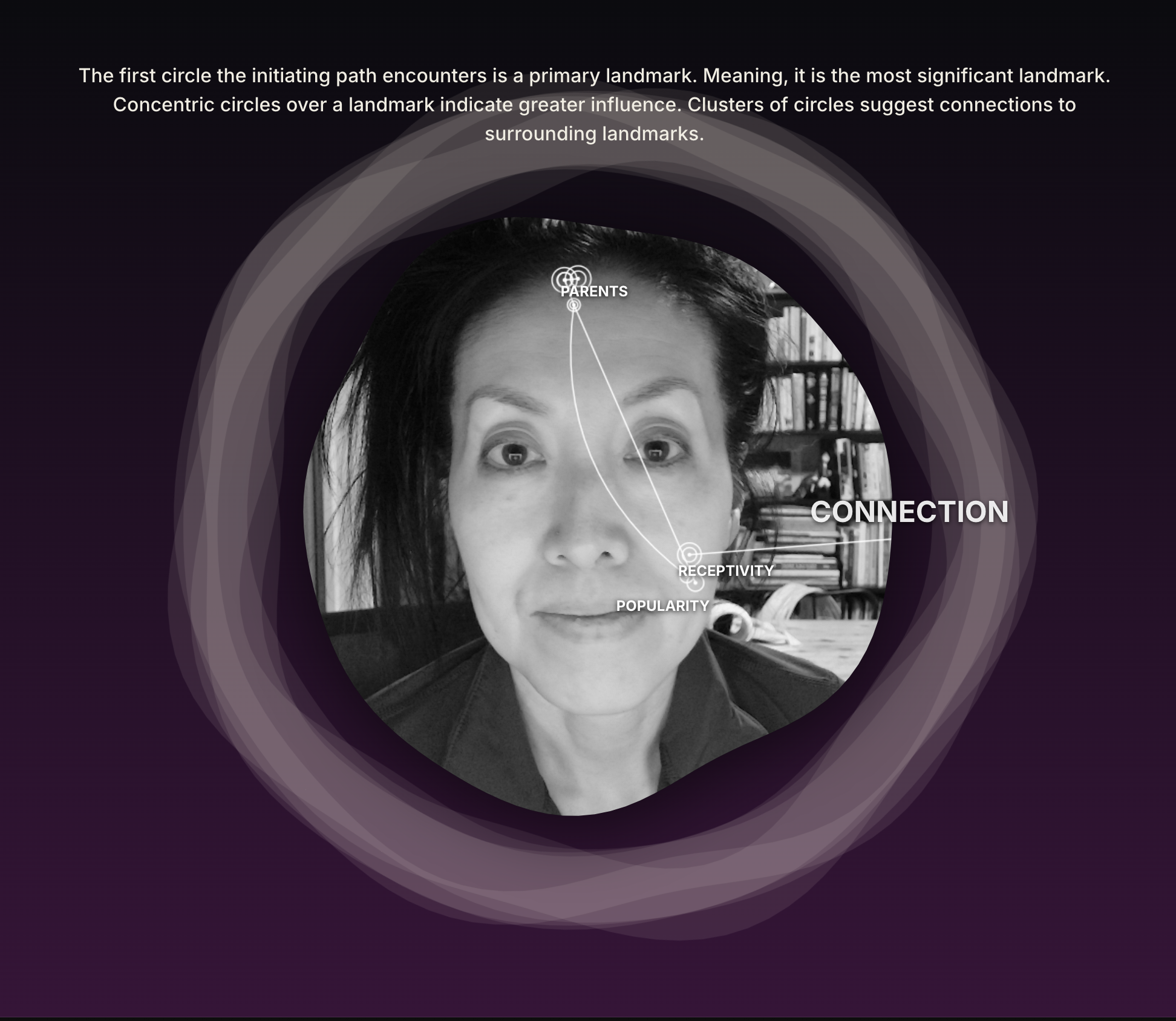
BEACON draws a map, a series of paths on your portrait, that group around landmarks on your face. Landmarks are regions of your face that have special meaning and the paths cluster where there is relevance to your initiating question.
Your image isn’t stored anywhere. BEACON has no need to use your imagine beyond facilitating a moment for you to see yourself more clearly. Here’s a guide to help you interpret your personal portrait/map.
Vocabulary
Prompt: Your initial question
Focus: The first step in your reading determines the focus of your map, is your path to understanding about Stability, Connection, Change, or Reflection.
Map: Your photo with lines and landmarks
Landmarks: These show up as circles on your map. They indicate what you need to consider when making decisions regarding your question.
Paths: On your map, you’ll see white lines connecting the landmarks. These aren’t linear paths, the future is more messy than that. But they do indicate relationship between landmarks. A straight line connecting two landmarks suggests a strong connection. A curving line suggests a softer, more gentle, relationship.
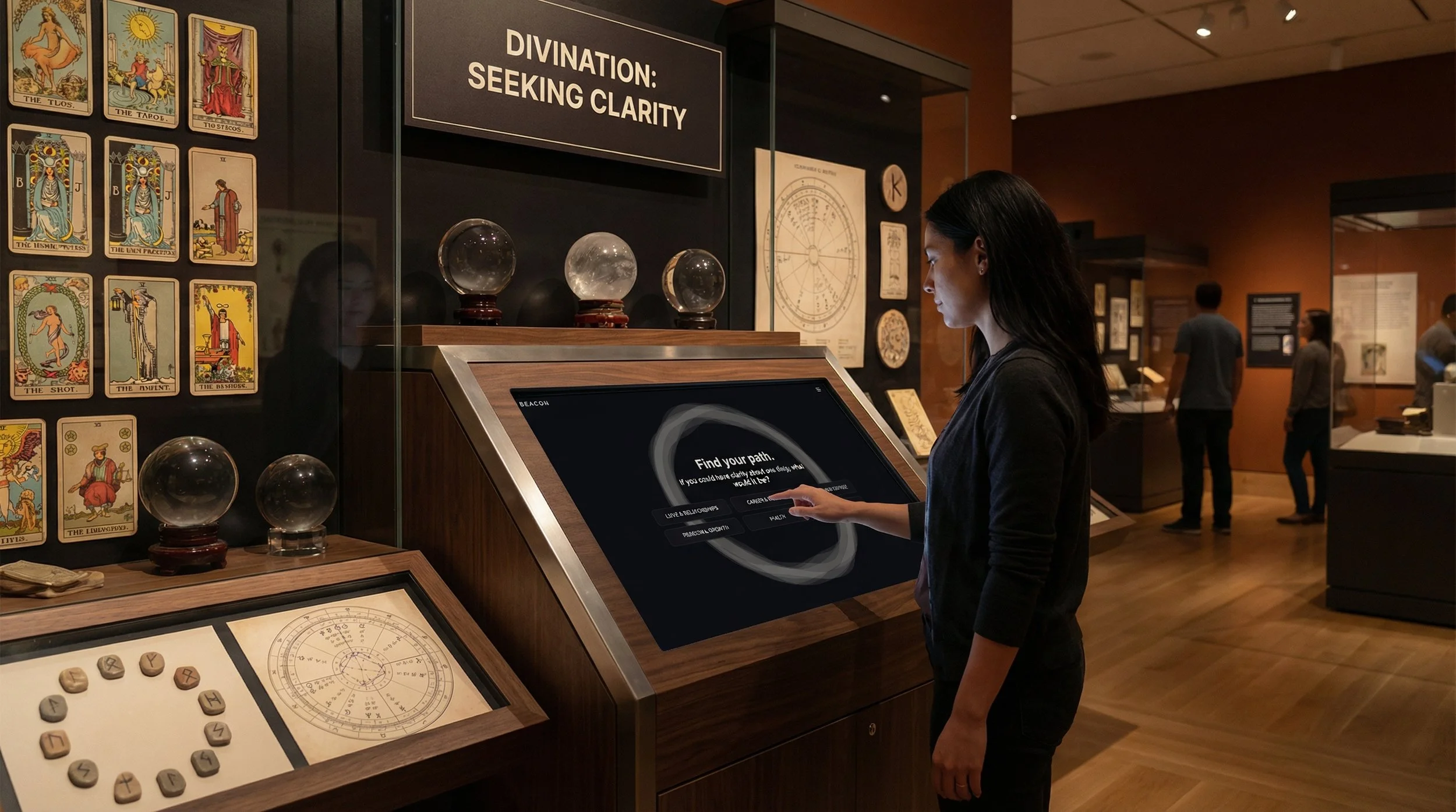
Step 1: Ask your question
The questions asked during divination sessions often gravitate towards health, wealth, relationships, purpose and growth.
Your first steps determines what type of question you have.
You are then asked to articulate, to yourself, a specific question.
Step 2: Determine the focus of your reading
After taking your photo the application will generate a map overlaid your face. This is your path.
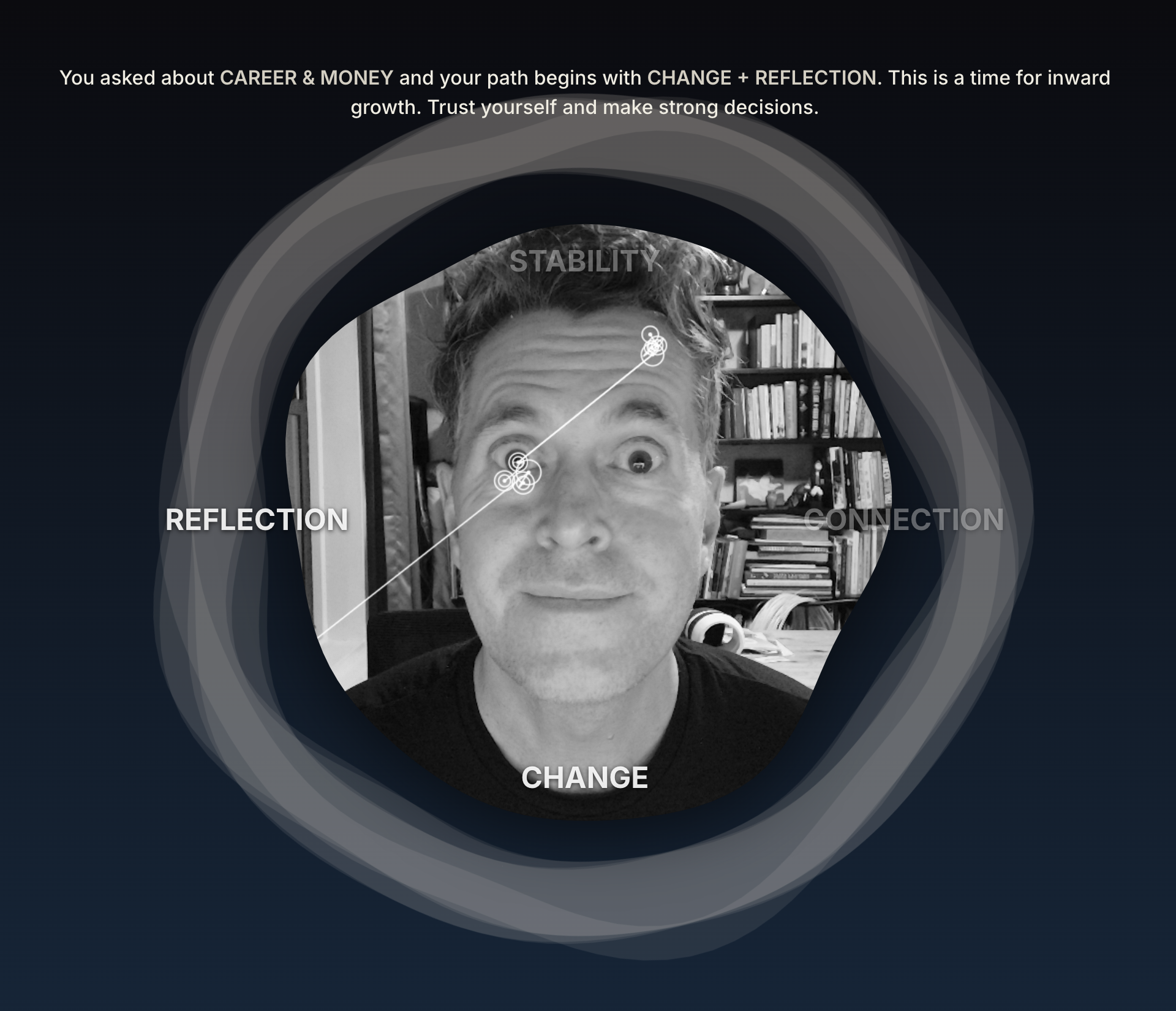
Note whether the line is drawn from the top, bottom, or either side of your portrait. This indicates the type of journey you are beginning.
Top/North = stability
Right/East= connection
Bottom/South = change
Left/West = reflection
Step 3: Reading your map
Your map is made of path and landmarks. Paths indicate the flow and connections between your landmarks.
Paths
Start with the path that begins at the edge of your portrait.
The position of that initiating path indicates the primary influence of your reading. Is the reading about Stability, Connections, Change, or Reflection? Or some combination of those?
The first circle the initiating path encounters is a primary landmark. Meaning, it is the most significant landmark.
Straight lines connecting nodes indicate a strong relationship between those concepts. Curving or wandering lines suggest a softer relationship between two connected nodes.
Landmarks
The lines and clusters of the map align to regions of significance on your face. These are landmarks. Essentially, traits and qualities that might influence decisions related to you question.
Look for circles on the map. They indicate which landmarks are most relevant to you and your question.
Step 4: Summary
The final step is a summary statement of your reading. It’s describes, in a simple sentence, the nature of your question, the focus of your reading, and relevant landmarks.